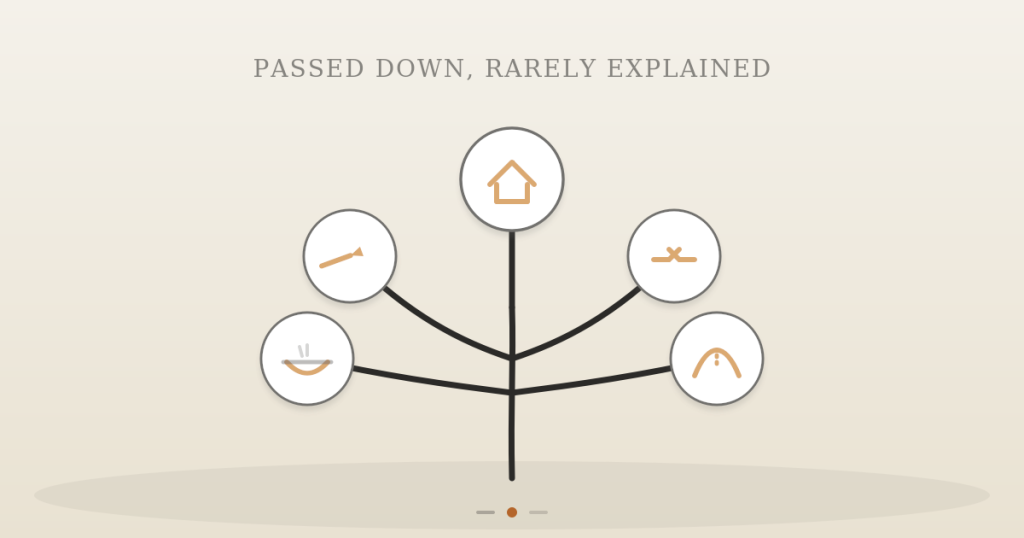
Every family has at least one tradition nobody can fully explain — a phrase, a recipe, a ritual that gets repeated every year without anyone quite remembering why. I decided to actually ask. Over the course of a month, I sat down with the relatives who still remember the origins, and pieced together where our strangest habits actually came from. Some of the answers were sweet. A few were sadder than I expected. One turned out to be a complete accident that just never stopped.
Here’s the full record, person by person, tradition by tradition.
The Grandmother: “Never Cut the Bread With the Knife Facing You”
I’d heard this rule my entire life and never once questioned it — you always turn the bread so the knife faces away from the person cutting. I assumed it was a safety thing. It’s not.
My grandmother explained that this came from her own mother, who grew up during a period of real scarcity, when bread wasn’t something you wasted or handled carelessly. Turning the knife away from yourself was a small, physical way of showing respect for the food — a reminder, every single time, that you weren’t entitled to it, that someone had worked hard for it to exist at all. Over decades, the meaning faded and the gesture stayed. Nobody in my generation could tell you why we do it. We just do it, automatically, the way you’d flinch from a hot stove.
Hearing the actual reason changed the ritual for me. It’s not superstition. It’s a tiny, physical prayer of gratitude that outlived the explanation for almost sixty years.
The Great-Uncle: The Phrase “Going to See a Man About a Dog”
This one is the family’s most-used, least-explained saying. Anytime someone left the house without saying where they were going, this was the excuse — “going to see a man about a dog.” I always assumed it was just a nonsense family joke, invented by someone, sometime, for no particular reason.
My great-uncle laughed for a solid thirty seconds when I asked him directly. It turns out it wasn’t invented by the family at all — it was a common evasive phrase from decades ago, used by people who didn’t want to say they were going to the racetrack or somewhere else they’d rather not name. Our family adopted it, half-ironically, after my great-grandfather used it constantly and never once actually explained where he was going. Eventually it became a private joke that outlived the original reason for the secrecy. Now it’s just what you say when you’re leaving and don’t feel like elaborating, and everyone in the family accepts it without question, exactly the way it was originally designed to work.
The Aunt: The Christmas Eve Soup Nobody Actually Likes
Every single Christmas Eve, without fail, there’s a specific soup on the table that, as far as I can tell, no one in three generations has ever finished a full bowl of. I always assumed it was tradition for tradition’s sake — the kind of thing that continues purely out of inertia.
My aunt told me the real story, and it’s more complicated than I expected. The soup was originally made by a family member who passed away before I was born, someone my aunt described as difficult but deeply loved, the kind of person the whole family orbited around without fully realizing it until she was gone. The soup wasn’t actually good even when she made it — my aunt was very clear about that — but making it every year became less about the taste and more about a fifteen-minute window every December where everyone in the kitchen tells at least one story about her while it simmers. Nobody’s ever suggested retiring the recipe, even though, by my aunt’s own admission, “it’s genuinely not great.” The soup isn’t really about the soup.
The Cousin: The Handshake That Isn’t a Handshake
Among the cousins on one side of the family, there’s a specific greeting — part handshake, part shoulder bump, ending with both people saying the same made-up word — that none of us can remember learning. You just know it by the time you’re old enough to participate, the way you know your own name.
My oldest cousin, who’s about a decade older than me, remembers the actual invention of it. He and his brother made it up as kids, mostly out of boredom, during a long summer where their parents worked a lot and the two of them were largely left to entertain themselves. It started as something private between just the two of them and slowly got absorbed by every cousin who came after, generation after generation, without anyone formally teaching it — younger kids just watched older kids do it and copied it, the way traditions spread in families without ever being written down anywhere. It’s now been performed by four generations of cousins who have no idea it started as two bored brothers killing time on a slow afternoon in a driveway.
The Father: Why We Always Take the Long Way Home From the Airport
This one I actually suspected had a real story behind it, because it’s oddly specific — every single time someone in the family is picked up from the airport, the driver takes a longer route home that goes past a particular overlook, even when it adds fifteen minutes to the trip.
My father confirmed it does have a real story, and it’s one he doesn’t tell often. Early in his marriage, before I was born, there was a period where he traveled constantly for work, and my mother would pick him up from every single trip. The overlook was where they used to stop, just for a few minutes, before heading home — not for any special occasion, just as a way of marking the transition back into normal life together before the routine of home swallowed the moment whole. After I was born, the stops became less frequent, but the route stayed. Now every family member does it without necessarily knowing why, treating it as a slightly odd quirk of local geography rather than what it actually is: a small, moving monument to something that mattered enough to become permanent, twenty-five years after the original reason for it mostly faded from daily life.
The Mother: The Rule About Never Whistling Indoors
Growing up, whistling inside the house was treated as something between a minor offense and a genuine bad omen, enforced with real seriousness despite nobody explaining why. I always assumed it was an arbitrary preference, the kind of small rule parents invent just to have one more thing to correct kids about.
My mother’s explanation surprised me. It came from her own grandmother, who held a belief — common in the culture she grew up in — that whistling indoors invited bad luck or attracted unwanted attention from something unseen. My mother doesn’t believe this literally, she was clear about that, but she also admitted she still can’t bring herself to whistle inside a house, even now, even alone, even knowing exactly where the rule came from and not believing a word of the original reasoning. Some habits apparently outlive belief entirely and just become reflex.
The Family as a Whole: What All of This Adds Up To
Putting these stories together, a pattern showed up that I wasn’t expecting when I started asking. None of these traditions started as traditions. Every single one of them began as something small, specific, and largely unremarkable at the time — a habit born from scarcity, an inside joke between two bored kids, a stop at an overlook that meant something only to two people. Nobody ever sat down and decided “this will be a tradition now.” They just kept happening, quietly, past the point where anyone remembered exactly why, until repetition itself became the meaning.
The strangest part of doing these interviews wasn’t learning the origins — it was realizing how close some of them came to being lost entirely. My great-uncle is the only person left who remembers the actual context behind “seeing a man about a dog.” My aunt is one of a shrinking number of people who can still tell you why the soup matters. In another decade or two, some of these stories will exist only in whatever form I manage to preserve them in now, which is, in the end, probably the real reason I started asking in the first place.
How to preserve family traditions without pretending memory is perfect
This essay is built from family recollection. Oral history can preserve details that never reached an archive, but it also contains disagreement, embellishment, gaps, and stories repeated so often that nobody remembers the first version. The responsible approach is to preserve both the story and the uncertainty around it.
What this can — and cannot — show
A relative’s memory is evidence of what they remember, not automatic proof that every date or origin is historically correct. Publishing family stories also raises privacy questions that do not exist in a private notebook. Names, health details, conflicts, addresses, and stories about people who did not consent deserve extra care.
Try the exercise yourself
- Record the tradition first: what happens, who usually does it, when it happens, and what people say it means.
- Ask different relatives separately where they think it came from. Do not force conflicting versions into one neat answer.
- Save dates, recipe cards, photographs, letters, or other records when they genuinely help verify a detail.
- Ask permission before publishing a story that identifies a living relative or reveals something private about them.
- Preserve uncertainty in the final version. “No one agrees on when this started” can be more truthful than a confident but invented origin.
Leave a Reply