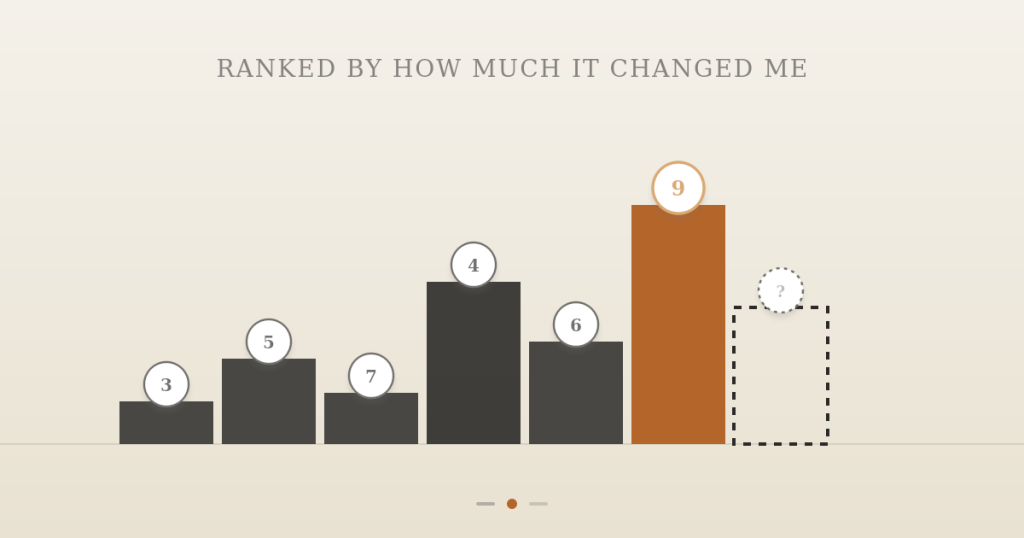
Most “career retrospective” posts rank jobs by pay, or prestige, or how much they look good on a resume. I wanted to do something different: go through every job I’ve ever had, in order, and rank them by how much each one actually changed who I am. Not what I learned in the technical sense, but who I became because of it — the habits, the fears, the confidence, the scar tissue.
Here they are, in chronological order, each with its actual transformation score out of 10.
Job 1: Ice Cream Shop, Age 16
Change Score: 3/10
My first real job taught me almost nothing about ice cream and a surprising amount about adults. I learned that grown men in suits will absolutely have a full meltdown over being given the wrong size cup, and that the manager who seemed terrifying on day one was actually the only person who ever covered my shift without complaint when I needed to leave early for something. It didn’t change me deeply, but it was the first time I understood that authority and kindness aren’t always the same axis.
Job 2: Grocery Store Cashier, Age 17–18
Change Score: 5/10
This job is where I learned to talk to strangers without it being a big deal. Before this, small talk terrified me. After eighteen months of scanning groceries and making comments about the weather to hundreds of people a week, it stopped being a performance and started being automatic. I also learned, the hard way, what it feels like to be blamed publicly for something that wasn’t my fault — a price mismatch that had nothing to do with me — and how much it matters whether the person watching you get blamed says something or stays quiet. I’ve thought about that moment more than almost anything else from that year.
Job 3: Summer Camp Counselor, Age 19
Change Score: 7/10
Being responsible for eight ten-year-olds for eight weeks straight rewired something in me. I stopped being the person who needed things figured out for me and became, almost overnight, the person other people looked to for that. There’s a specific kind of confidence that only comes from a kid crying at 2 a.m. because they’re homesick, and you being the only adult in the room who can do anything about it. I left that summer noticeably calmer under pressure than I’d been in May, and it’s a version of calm that’s never fully gone away.
Job 4: Coffee Shop, Age 20 (During College)
Change Score: 4/10
Mostly this job taught me how to function on very little sleep while being pleasant to strangers, which turned out to be a more transferable skill than anything I learned in my actual classes that semester. The real shift came from one regular customer, an older man who came in every single morning and eventually started asking me real questions about my life — not small talk, actual questions. He was the first adult outside my family who seemed genuinely curious about who I was going to become, rather than just being polite about it.
Job 5: Marketing Internship, Age 21
Change Score: 6/10
This was the first job that made me doubt myself in a new way — not “can I do the tasks” doubt, but “do I actually want this life” doubt. I was good at the work. I was also miserable in a way I didn’t have language for yet, sitting in fluorescent-lit meetings about campaign metrics, watching people twice my age look just as disengaged as I felt. It didn’t change my skills much, but it planted the first real seed of “the traditional path isn’t automatically the right path for me,” which took years to fully grow into anything actionable.
Job 6: Restaurant Server, Age 22–23
Change Score: 8/10
Serving tables changed me more than almost any other job on this list, and I didn’t expect that going in. It taught me how to read a room in seconds, how to de-escalate someone’s bad day without absorbing it as my own, and how to keep moving forward through embarrassment — spilled drinks, forgotten orders, a table of ten all talking over each other — without letting any single bad moment define the whole shift. I also learned what it’s like to be treated as invisible by people I was actively serving, and I made a quiet promise to myself about how I’d treat service workers for the rest of my life. That promise has held.
Job 7: First “Real” Office Job, Age 24
Change Score: 5/10
This is the job that taught me the difference between being busy and being valuable, and how long it can take to notice that difference from the inside. I spent the first year assuming that visible effort was the same as impact, until a manager gently pointed out that I was optimizing for looking productive rather than being useful. It stung. It was also correct, and it’s a lesson that’s quietly shaped how I approach every job since.
Job 8: Startup, Age 25–27
Change Score: 9/10
Nothing changed me faster or more completely than three years at a company that was, depending on the week, either about to fail or about to take off. I went from someone who needed a clear job description to someone who could walk into a problem nobody had assigned and just start solving it. I also learned what burnout actually feels like from the inside, not as a concept but as a physical, specific thing, and what it costs to ignore it for too long because the work felt important. I left that job both more capable and more depleted than I’d ever been, and it took real time afterward to figure out which parts of that trade were worth it and which weren’t.
Job 9: Current Job
Change Score: 6/10 (so far)
Too early to give this one a final number, since I’m still inside it. What I can say is that this is the first job where the change has been quieter — less about survival or capability and more about pace. I’m learning, slowly, what it looks like to do good work without treating every week like a crisis, which is a skill none of the previous eight jobs ever had the chance to teach me, because none of them were built to allow it.
What the Ranking Actually Shows
Laid out chronologically, the pattern is less about the jobs themselves and more about timing. The highest-change jobs — camp counselor, server, startup — all shared something in common: they put me in situations with real, immediate consequences and very little safety net, at ages when I hadn’t yet built up enough of a fixed identity to resist changing. The lowest-change jobs were the ones that were either too short, too structured, or too similar to something I’d already done to require me to become anyone different in order to survive them.
If there’s a lesson in ranking a decade of employment this way, it’s that the jobs that changed me most were rarely the ones that looked best on paper at the time. The prestigious internship barely moved the needle. The ice cream shop and the restaurant, jobs I once described dismissively as “just something to pay for school,” did more to shape who I actually am than almost anything that came after.
How to rank jobs by impact instead of prestige
This ranking asks a different question from salary tables or career ladders: which jobs changed the writer most? The score is retrospective and personal. It weighs things such as confidence, habits, tolerance for uncertainty, communication, and the way later choices were shaped — not whether the employer was objectively good or the role is right for someone else.
What this can — and cannot — show
Hindsight can make an old job look more meaningful because later events gave it a story. Memory also compresses routine months and highlights dramatic moments. This kind of audit is useful for understanding your own career narrative, but it is not labour-market research and should not be read as a ranking of professions.
Try the exercise yourself
- List every paid role, internship, major volunteer role, or caregiving period you consider part of your work history.
- Score each role on two separate questions: what skill did it change, and what belief about work did it change?
- Write one concrete example for each score so the ranking is not based only on mood.
- Compare the result with your CV. Notice which formative experiences are missing because they look less prestigious.
- Use the audit to identify what you want more of — autonomy, teamwork, craft, stability, public contact — in the next role.
Leave a Reply